Persian Rug Cleaning Sydney
Specialist Persian Rug Cleaning Sydney
Oriental Rug Care provides specialist Persian rug cleaning and washing in Sydney for hand-knotted, wool, silk, antique and valuable Persian rugs from Tabriz, Kashan, Isfahan, Kerman, Heriz, Nain, Qum and other weaving regions. Every rug is inspected and tested before cleaning so the safest method can be chosen for that specific rug, not a generic one.
Persian rugs are not carpet, and they shouldn’t be cleaned like it. A hand-knotted Persian rug is built from wool pile, cotton or silk foundation, natural or metal-mordant dyes, hand-tied fringe and knot densities that can range from under 100 to well over 500 knots per square inch. Two rugs that look similar side by side can need completely different chemistry, water temperature and drying time. The wrong choice can cause dye bleed, foundation shrinkage, browning, pile distortion or permanent colour loss.
At Oriental Rug Care, every Persian rug is assessed on its own merits: region and construction, dye stability, fringe and side-cord condition, existing repairs, staining, odour and contamination, before we decide whether it needs full-immersion washing, low-moisture cleaning, targeted stain and odour treatment, or repair before cleaning begins.
Need a Persian rug cleaning quote in Sydney?
Call 1300 310 410 for advice or complete the form below for a free quote.
Quick Answer: How Should a Persian Rug Be Cleaned?
A Persian rug should be cleaned through a specialist process, not standard carpet steam cleaning. The safest process identifies the rug’s weaving region and construction, tests dye stability, removes dry soil from deep in the pile and foundation, then applies controlled washing or low-moisture cleaning followed by rinsing, pH correction, fringe care and slow, controlled drying.
The right method depends on the rug’s age, region, fibre and dye stability, and current condition. A robust wool Kashan or Tabriz in good condition will usually tolerate full washing well. A fine silk Isfahan, an antique tribal piece, or any rug with unstable dyes needs a far more conservative approach. Cleaning always begins with inspection, region and fibre identification, and dye testing before the rug’s construction, foundation and fringe are properly assessed.
Why Persian Rugs Need Specialist Cleaning
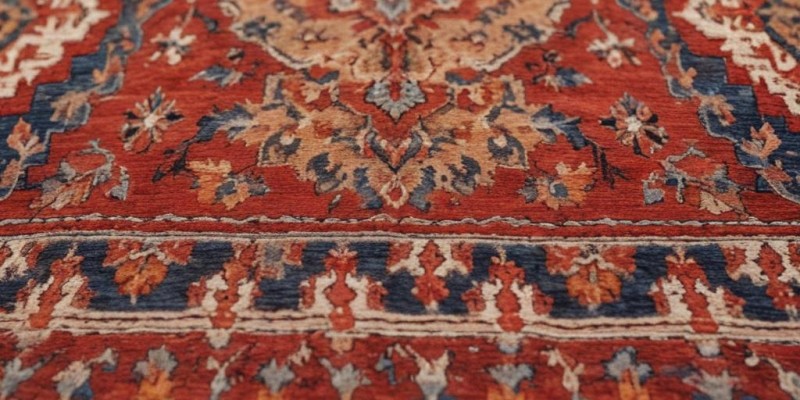
A genuine Persian rug is a handmade textile, usually knotted by hand over months, sometimes on a family loom passed down for generations. It isn’t a floor covering in the way fitted carpet is — it’s closer to a woven artwork that happens to sit on a floor.
General carpet cleaning equipment and chemistry is built for synthetic, fitted broadloom. It’s designed to extract quickly and dry fast on a surface that won’t shrink, bleed or distort. A Persian rug behaves nothing like that. Soil, grit and skin cells settle deep into the pile and foundation over years, and the wrong moisture, agitation or drying time can affect:
- Wool pile structure and lustre
- Silk pile or silk highlights
- Cotton or silk foundation strength
- Hand-tied fringe and side cords
- Natural and synthetic dyes, particularly reds, blacks and indigo blues
- Pattern definition and pile height
- Long-term resale and heirloom value
Persian Rug Regions and What They Mean for Cleaning
Most Persian rugs are named after the city, town or tribal region where they were woven, and that origin says a lot about how the rug should be cleaned. This is one of the first things we assess, because a Tabriz and a Kashan can require noticeably different handling even though both are described as “Persian.”
Tabriz rugs
Woven in Iran’s north-west, Tabriz rugs range widely in knot density and quality, from coarser village pieces to very finely knotted city rugs. Most have a wool pile on a cotton foundation, sometimes with silk highlights. Because quality and construction vary so much within the Tabriz name, we test each one individually rather than assuming.
Kashan rugs
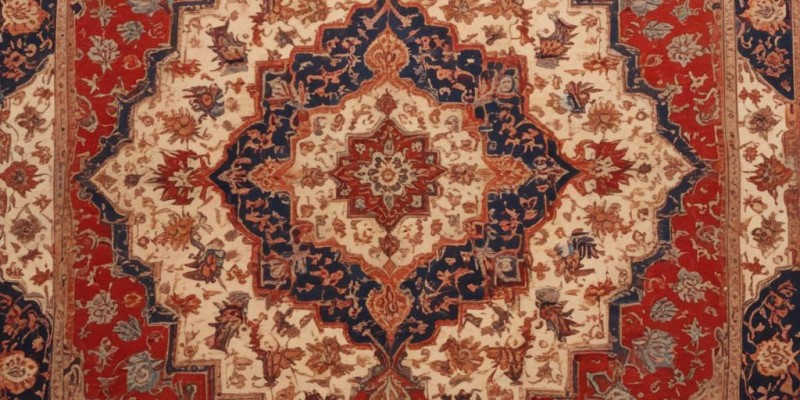
Kashan rugs are the classic “Persian rug” image most people picture: a central medallion on a densely floral field, typically in deep reds, navy and ivory, wool pile on a cotton foundation. They’re generally robust and respond well to controlled full washing, though older pieces still need dye testing before anything else.
Isfahan rugs
Among the finest Persian weaving, Isfahan rugs often carry very high knot counts and may use silk highlights on a wool or silk foundation, or be woven entirely in silk. These rugs need a more cautious, low-moisture approach in many cases, particularly where silk is present, because silk can water-mark, lose sheen or change texture if handled like wool.
Kerman rugs
From south-central Iran, Kerman rugs typically have a cotton foundation and can show intricate floral, medallion or pictorial designs in strong reds with neutral tones. Foundation condition is worth checking closely on older Kerman pieces before washing.
Heriz rugs
Heriz rugs are usually larger, heavier and more geometric, with a hardy wool pile on a cotton warp. They tend to be more forgiving during washing than finer city rugs, but their size and weight make correct handling and drying particularly important.
Nain and Qum rugs
Nain rugs are known for low pile and very fine, precise knotting, often with cream or ivory grounds. Qum rugs are frequently woven partly or fully in silk. Both call for gentler, low-moisture methods rather than aggressive washing.
Why this matters to you:
Knowing (or finding out) which of these your rug belongs to isn’t trivia — it’s the first input into choosing a safe cleaning method. If you’re not sure what you have, that’s exactly what our inspection is for.
Hand-Knotted or Machine-Made? Why It Changes the Cleaning Method
Not every rug sold as a “Persian rug” is genuinely hand-knotted, and this affects how it should be cleaned. A true hand-knotted Persian rug shows individual knots and a visible weave structure on the back, with the pattern often slightly less crisp on the reverse than the front. A machine-made or hand-tufted rug usually has a uniform woven or glued backing, sometimes with a visible fabric or latex layer.
Hand-tufted rugs in particular can trap moisture and odour in their latex backing, which changes the safest cleaning approach. Genuine hand-knotted Persian rugs, by contrast, are typically foundation-and-pile only, with no adhesive backing, which is part of why full immersion washing can be appropriate for many of them once dyes have been tested.
If you’re not sure which you have, our technicians check this as a standard part of inspection, before any cleaning method is chosen.
Our 12-Step Persian Rug Cleaning Process
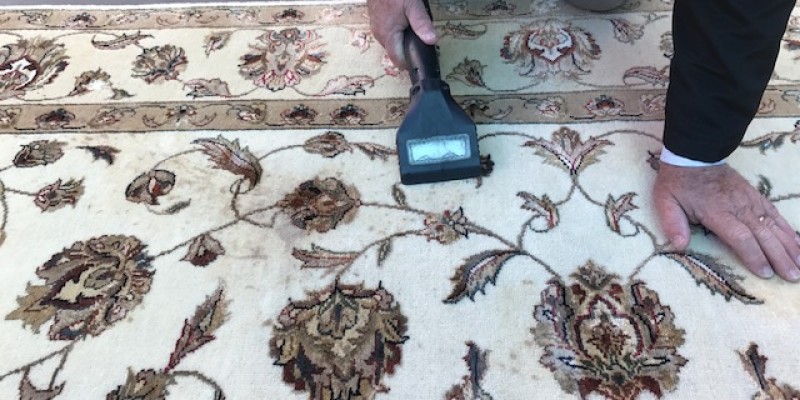
Every Persian rug is different, so the exact combination of steps is adjusted to the rug. This is the process our technicians work through for most hand-knotted Persian rugs brought into our Sydney facility.
1. Pickup and intake assessment
We collect the rug from your home or office and record its size, suspected region, known history, stains, odours, pets and any previous cleaning attempts.
2. Fibre and construction identification
We confirm whether the pile is wool, silk or a wool-silk blend, and identify the foundation material and knotting style.
3. Dye stability testing
Every colour in the rug is tested for bleed risk before any moisture is introduced. This is non-negotiable for Persian rugs, particularly older pieces and reds.
4. Dry soil removal
Using mechanical dusting and compressed air where suitable, dry grit and sand are shaken and extracted from deep in the pile and foundation before washing. Skipping this step is one of the most common causes of a poor result, because wet dry-soil simply turns to mud inside the rug.
5. Pre-spotting
Visible stains and heavily soiled traffic areas are pre-treated with rug-appropriate products chosen for the specific stain and fibre.
6. Full immersion washing or low-moisture cleaning
Where dye testing and condition allow, the rug is fully submerged and gently hand-washed using WoolSafe-approved systems and rug-specific detergents such as MasterBlend Oriental Rug Shampoo. Where the rug is dye-sensitive, silk, antique or otherwise unsuitable for immersion, we use a controlled low-moisture method instead.
7. Fringe cleaning
Fringes are cleaned separately from the body of the rug, since they’re often more fragile and can carry more embedded soil, urine or discolouration than the rest of the pile.
8. Thorough rinsing
The rug is rinsed with clean water, repeated until residue is gone, using products such as MasterBlend MasterRinse where appropriate. Poor rinsing is one of the main causes of rugs re-soiling quickly after cleaning.
9. pH correction
Wool fibre needs to be returned to a balanced pH after washing. Skipping this step can leave wool feeling harsh, sticky, or prone to attracting soil again quickly.
10. Odour treatment where needed
Where pet urine, mustiness or smoke odour is present, an appropriate odour-encapsulating treatment is applied as part of the wash, not as a surface spray afterwards.
11. Controlled drying
The rug is dried flat in a purpose-built, ventilated drying space, monitored to prevent browning, dye migration, uneven shrinkage or mildew.
12. Final inspection and return
Before the rug is returned, we check colour, texture, fringe condition and pile recovery, and flag anything that would benefit from repair or further attention.
Persian Rug Washing, Low-Moisture Cleaning or Decontamination?
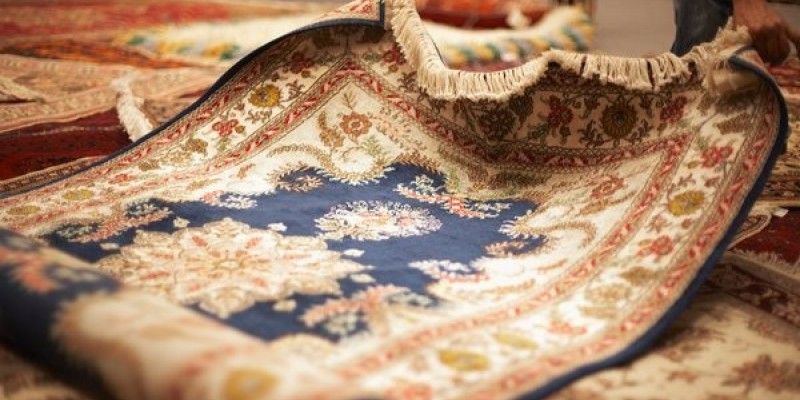
Not every Persian rug should be cleaned the same way. The right choice depends on region, fibre, dye stability and current condition.
Full immersion washing
Suitable for most robust wool Persian rugs — typically Kashan, Heriz and many Tabriz pieces — once dye testing confirms it’s safe. This is the most thorough option because it flushes soil, urine and residue from deep in the foundation rather than just the visible pile. See our rug washing Sydney service.
Low-moisture cleaning
Recommended for silk and part-silk rugs such as many Isfahan and Qum pieces, dye-sensitive rugs, and rugs in fragile condition where full immersion carries too much risk. See our rug dry cleaning Sydney page.
Decontamination
Needed where a rug has pet urine, mould, flood water or heavy microbial contamination. This goes beyond routine cleaning and typically needs a dedicated flushing and treatment process rather than a standard wash cycle.
Specialist advice:
If your Persian rug has urine, mould, water damage, dye bleed, smoke odour or old stains, tell us before booking. These factors can change the safest treatment method entirely.
Pet Urine on Persian Rugs
Pet urine is one of the most damaging things that can happen to a Persian rug, because it doesn’t stay on the surface. It travels down through the wool pile into the cotton or silk foundation, along knots, and into the fringe, where it can sit for months without an obvious smell until humidity brings it back.
The real risk is delayed dye movement. A rug can look untouched for weeks after a urine accident, then start showing colour change or browning as the salts and acidity continue reacting with the dyes and fibres. Surface deodorising doesn’t fix this because it doesn’t reach the contamination.
Proper treatment usually needs controlled flushing, pH correction, targeted odour treatment and slow, monitored drying. See our pet urine and odour removal Sydney service for more detail.
Stain and Odour Treatment for Persian Rugs
Wine, coffee, tea, food, pet accidents, watermarks, smoke and unidentified old stains are all things we see regularly on Persian rugs across Sydney. Every stain is assessed with dye testing first, because the wrong product on an unstable dye can do more damage than the original stain.
We’ll always give you a realistic view before we start: some stains lift completely, some improve significantly, and some — particularly old stains that have already had a household product applied — may be permanent. For visible marks, see our rug stain removal Sydney page. For smells without a visible cause, see rug odour removal Sydney.
Persian Rug Cleaning for Wool, Silk and Antique Rugs
Wool Persian rugs
Most Persian rugs — Kashan, Heriz, many Tabriz pieces — are wool pile on a cotton foundation. Wool cleans beautifully when the chemistry, rinsing and drying are right, and holds up well to full immersion washing in most cases. See our wool rug cleaning Sydney page.
Silk and part-silk Persian rugs
Isfahan, Qum and some fine Nain rugs may use silk in the pile or as decorative highlights. Silk is sensitive to moisture, agitation and drying speed, and can lose sheen, water-mark or change texture if handled the same way as wool. See our silk rug cleaning Sydney service.
Antique and heirloom Persian rugs
Rugs over 50–80 years old may have weakened foundations, old repairs, worn fringe or dyes that have shifted with age. These need conservative, inspection-led cleaning and honest expectations rather than a standard wash. See our antique and heirloom rug cleaning Sydney page.
Can Persian Rugs Be Cleaned at Home?
Regular vacuuming (pile side and backing, without a beater bar on fringe) and prompt blotting — never rubbing — of fresh spills is genuinely useful maintenance between professional cleans. Deep cleaning at home is a different matter and carries real risk for a hand-knotted rug.
Avoid bleach, laundry powder, dishwashing liquid, vinegar, bicarb paste, supermarket carpet sprays and hired carpet-cleaning machines on a genuine Persian rug. These can shift pH, cause dye bleed, leave sticky residue that attracts soil faster, or over-wet a foundation that then takes days to dry unevenly.
When Persian Rug Repair Should Be Considered Before Cleaning
Some Persian rugs need stabilising before they go anywhere near water. Weak fringe, separating foundations, holes, moth damage or loose side cords can all be made worse by the mechanical action of washing. We check for this during inspection and will always tell you if repair should come first. See our rug repair Sydney service for more information.
Pickup and Delivery for Persian Rug Cleaning Across Sydney
Persian rugs are often large, heavy and awkward to move safely, particularly from apartments, upper floors or homes without easy street access. Oriental Rug Care offers pickup and delivery across Sydney for eligible Persian rug cleaning jobs, including the Eastern Suburbs, Inner West, North Shore, Northern Beaches and Sutherland Shire.
This matters because a rug that’s dragged, folded tightly or half-dried at home can end up worse off than before. See our rug pickup and delivery Sydney service for more information.
Why Choose Oriental Rug Care for Persian Rug Cleaning?
- Genuine Persian rug specialists: We clean rugs from Tabriz, Kashan, Isfahan, Kerman, Heriz, Nain, Qum and other regions, not just generic “Oriental rugs.”
- Inspection-led, not assumption-led: Every rug is assessed for region, construction and condition before a method is chosen.
- Dye testing on every colour: We test before we wet, every time.
- Full 12-step process: Dry soil removal, full immersion or low-moisture washing, fringe cleaning, rinsing, pH correction and controlled drying.
- Purpose-built facility: Rugs are washed, rinsed and dried in a controlled environment, not squeezed into a domestic bathroom or driveway.
- Pickup and delivery: Available across Sydney for eligible Persian rug cleaning jobs.
- Strong customer proof: More than 50 five-star Google reviews from Sydney customers.
Customers regularly mention trusting Allan and Lachlan with valuable Persian, Oriental, silk and wool rugs — and specifically call out clear communication about what a rug can and can’t safely have done to it, rather than blanket reassurance.
What Customers Say About Our Persian Rug Cleaning
“Lachlan and Allan explained in detail the process for cleaning the rugs and gave us confidence they would be well looked after. Customer service was amazing! Lachlan returned our rugs to our apartment on level 23 and helped put them back down. The rugs look fabulous and we will now not wait so long between cleans so they are good for further generations.” — Sandy Madigan
“We recently had two Persian rugs professionally cleaned by Oriental Rug Care of Australia - Sydney. After cleaning, the result is astounding: it looks and feels just like new. And the quality of the cleaning for the second rug is equally excellent. Thank you!” — John Stanton
You can learn more about wool-safe cleaning standards from The WoolSafe Organisation. Oriental Rug Care also values recognised professional cleaning standards, including the work of the IICRC.
Helpful Related Services
If your Persian rug needs more than routine cleaning, these related services may help:
Persian Rug Cleaning Sydney FAQs
How should Persian rugs be cleaned?
Persian rugs should be cleaned through a specialist process that starts with inspection, region and fibre identification, and dye testing. Depending on the rug, this may include full immersion washing or low-moisture cleaning, fringe cleaning, rinsing, pH correction and controlled drying.
Can Persian rugs be steam cleaned?
Some machine-made rugs may tolerate light steam cleaning, but hand-knotted Persian rugs shouldn’t be steam cleaned like fitted carpet without inspection first. Heat, moisture and aggressive extraction carry real risk for dyes, fringe, wool pile and cotton foundations.
Can you wash Persian rugs?
Yes. Most wool Persian rugs — Kashan, Heriz and many Tabriz pieces — can be fully washed once dye testing confirms it’s safe. Silk, part-silk and dye-sensitive rugs often need a low-moisture method instead.
How do I know what type of Persian rug I have?
The clearest clues are the pile fibre (wool, silk or a blend), the pattern style (medallion, floral, geometric, pictorial), and colour palette. If you’re unsure, bring it in or send photos — our technicians can usually narrow down the likely region as part of the inspection.
How often should a Persian rug be cleaned?
Most Persian rugs benefit from professional cleaning every 12 to 24 months, depending on foot traffic, pets, children and where the rug sits in the home. Heavily used rugs and those in homes with pets often need cleaning closer to the 12-month mark.
Can pet urine be removed from a Persian rug?
Often, yes, but it needs specialist assessment. Urine travels into the pile, foundation and fringe, so surface deodorising alone won’t resolve it. Decontamination, pH correction and controlled drying are usually required.
Can you remove stains from Persian rugs?
Some stains can be removed and others can be improved. Results depend on the stain type, fibre, dye stability, age of the stain and previous cleaning attempts. We test and assess before treatment.
Do Persian rug fringes need separate cleaning?
Yes, in most cases. Fringes are often more fragile than the rug body and can hold more embedded soil, urine and discolouration, so they’re cleaned as a distinct step rather than left to whatever happens during the main wash.
Do you clean antique Persian rugs?
Yes, with a more conservative process. Older fibres, historic repairs, worn fringe and aged dyes all need careful assessment before we decide on a method.
Do you offer pickup and delivery?
Yes. Oriental Rug Care offers pickup and delivery across Sydney for eligible Persian rug cleaning, washing, stain removal, odour treatment and repair jobs.
How much does Persian rug cleaning cost in Sydney?
Pricing depends on the rug’s size, region, fibre, condition and whether it needs stain, odour, pet urine or repair work. Call 1300 310 410 for a free quote.
Book Persian Rug Cleaning in Sydney
If your Persian rug is valuable, hand-knotted, wool, silk, antique, stained, odour-affected or pet-contaminated, speak with a specialist before choosing a cleaning method.
Call 1300 310 410 or complete the form below for a free Persian rug cleaning quote in Sydney.
Oriental Rug Care provides specialist Persian rug cleaning in Sydney for wool, silk, antique, hand-knotted and modern rugs from Tabriz, Kashan, Isfahan, Kerman, Heriz, Nain, Qum and beyond.
Pickup and delivery is available across Sydney.