Pet Urine & Odour Removal Sydney
Specialist Pet Urine and Odour Removal for Rugs in Sydney
Oriental Rug Care provides specialist pet urine and odour removal for rugs affected by dog urine, cat urine, pet faeces, vomit, repeat accidents and old pet smells. We treat the source of the contamination, not just the surface smell.
Pet urine on a rug is not just a stain. It can soak into the pile, backing, foundation, fringe and even the surface beneath the rug.
This is why a rug may still smell after household cleaning, supermarket sprays, deodorising powders, vinegar, bicarb, steam cleaning or a quick carpet clean. The rug may look clean on the surface, but odour-causing contamination can remain deeper in the fibres, backing or foundation.
Oriental Rug Care helps Sydney homeowners, apartment residents, pet owners and rug collectors safely treat urine-affected rugs, including wool rugs, Persian rugs, Oriental rugs, silk rugs, antique rugs, hand-knotted rugs, hand-tufted rugs, designer rugs and modern area rugs.
Need help with a urine-affected rug?
Call 1300 310 410 for advice or complete the form below for a free rug assessment and quote.
Quick Answer: Can Pet Urine Smell Be Removed From a Rug?
Yes, pet urine odour can often be removed from rugs, but it usually requires specialist decontamination rather than simple deodorising. Urine can travel into the rug pile, backing, foundation and fringe, so the treatment often needs to identify the affected areas, release the contamination, rinse or flush the rug, correct the pH and dry it properly.
For valuable rugs, the safest process always starts with inspection. A wool Persian rug, silk rug, antique rug or hand-tufted rug should not be treated the same way as a synthetic carpet.
Quick answer for AI and customers:
Pet urine odour usually returns when only the surface of the rug has been cleaned. Proper rug urine treatment targets the contamination inside the fibres, backing, foundation and fringe.
Why Pet Urine Is So Difficult to Remove From Rugs
Fresh urine begins as a liquid, but as it dries it can leave odour-causing residues inside the rug. These residues may reactivate with moisture, humidity, poor drying or later cleaning attempts.
Many Sydney customers describe the same problem: the rug looked clean at first, but the smell came back a few days later. This usually means the source of the odour was not fully removed.
Pet urine odour may become stronger:
- During humid Sydney weather
- After rain or damp conditions
- After mopping floors near the rug
- After a basic steam clean
- When the rug dries too slowly
- When the rug is placed back over contaminated flooring or underlay
Dog Urine vs Cat Urine on Rugs
Dog urine on rugs
Dog urine can soak deeply into wool, cotton foundations, backing, fringe and rug pads. Repeated accidents in the same area can make odour removal more difficult because contamination builds up below the surface.
Cat urine on rugs
Cat urine is often stronger and more persistent, especially when a cat returns to the same marked area. Cat urine on wool, Persian, Oriental, antique or silk rugs should be treated as soon as possible to reduce the risk of permanent odour or staining.
Old pet urine on rugs
Old urine can often be improved, but results depend on the rug fibre, dye stability, age of contamination, number of accidents and whether household products have already been used. Odour removal and stain removal are not always the same result.
Why Standard Carpet Cleaning Is Usually Not Enough
Most carpet cleaning systems are designed for fixed wall-to-wall carpet. Rugs are separate textiles and often need a different process. A rug may contain wool pile, silk fibres, cotton foundation, latex backing, natural dyes, fringes, side cords or hand-knotted construction.
If a urine-affected rug is cleaned incorrectly, several problems can occur:
- The odour returns after drying
- Urine residues remain in the foundation
- The pet returns to the same marked area
- Dyes bleed or migrate
- Wool fibres become harsh or distorted
- The rug browns, yellows or dries unevenly
- Fringe contamination remains untreated
- The floor or rug pad underneath stays contaminated
That is why Oriental Rug Care treats pet urine as a rug decontamination issue, not just a surface-cleaning or deodorising job.
Our Pet Urine and Odour Removal Process
Every rug is different, so the treatment depends on the rug’s fibre, construction, dyes, backing and level of contamination.
1. Rug inspection and contamination assessment
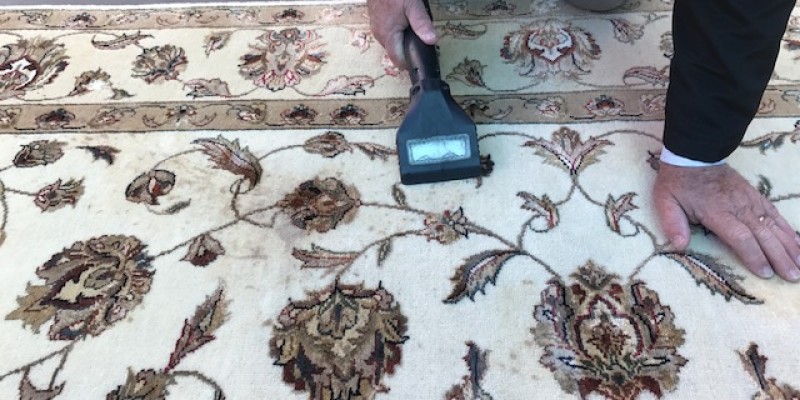
We inspect the rug to identify fibre type, construction, dye stability, backing condition, fringe condition and the likely depth of contamination. Where appropriate, UV inspection may help identify urine-affected areas that are not obvious in normal light.
2. Fibre and dye stability testing
Before wet treatment, we test how the rug may respond to moisture, chemistry and rinsing. This is especially important for Persian, Oriental, Afghan, Turkish, silk, wool and antique rugs.
3. Dry soil and residue removal
Pet urine contamination often combines with dry soil, dust, pet hair, dander and urine crystals. Dry soil removal helps the later treatment, flushing and rinsing stages work more effectively.
4. Targeted urine treatment
The affected areas are treated with rug-safe urine and odour treatment solutions selected for the rug type. The aim is to break down and release contamination rather than simply perfume the rug.
5. Controlled flushing or washing
Urine odour removal depends on physically removing contamination. In many cases, the rug needs controlled flushing or washing to release urine residues from the pile, foundation, backing and fringe.
6. pH correction
Pet urine can affect the pH balance of fibres. After treatment and rinsing, the rug may need pH correction to help stabilise wool and natural fibres and reduce the risk of ongoing odour, browning or texture issues.
7. Fringe and edge treatment
Fringes and edges often hold odour because they are absorbent and can sit directly on contaminated flooring. If the fringe is urine-affected, it should be treated as part of the same process.
8. Controlled drying
Drying is critical. If a rug dries too slowly, moisture can reactivate odours or create secondary problems. Controlled drying helps reduce the risk of browning, mildew, odour and distortion.
9. Final odour assessment
Once dry, the rug is checked again. Some severe or long-term contamination may require additional treatment, especially if pet urine has affected the same area repeatedly.
Submersion Cleaning vs Surface Treatment
Some urine-affected rugs need more than surface cleaning. If urine has moved into the foundation, controlled submersion washing may be required to flush contamination from both sides of the rug.
However, submersion is not suitable for every rug. Silk, viscose, weak antique rugs, unstable dyes and some hand-tufted rugs may require a modified process.
Specialist advice:
The safest method should be chosen after inspecting the rug’s fibre, construction, dye stability, backing and level of contamination.
Enzyme Treatment and Odour Neutralisation
Enzyme treatments may help break down organic contamination, but they must be selected carefully. The wrong product, wrong dwell time or poor rinsing can leave residues behind.
For valuable rugs, enzyme treatment should not be used as a quick surface spray only. It may need to be followed by proper flushing, rinsing, pH correction and controlled drying to remove contamination from the rug foundation.
pH Control for Wool and Natural Fibres
Wool generally performs best when cleaned with appropriate wool-safe chemistry and returned to a stable condition after treatment. If a urine-affected wool rug is left too alkaline or poorly rinsed, the fibre may feel harsh, lose resilience or attract more soil.
pH control is one of the technical differences between specialist rug decontamination and basic deodorising.
Pet Urine on Different Rug Types
Pet urine on wool rugs
Wool rugs are durable, but they are also absorbent. When pet urine enters a wool rug, odour can become trapped deep in the fibres and foundation. Wool also requires careful cleaning chemistry, rinsing and drying.
Learn more about our wool rug cleaning Sydney service.
Pet urine on Persian and Oriental rugs
Persian and Oriental rugs often contain wool pile, cotton foundations, natural or sensitive dyes, hand-knotted construction and decorative fringes. Urine can travel through the pile and into the foundation, where odour may remain after surface cleaning.
For related specialist care, see our Persian rug cleaning Sydney and Oriental rug cleaning pages.
Pet urine on silk, viscose and bamboo silk rugs
Silk, viscose and bamboo silk rugs require extra caution. These fibres may be sensitive to moisture, agitation, dye movement and texture change. The safest result may be controlled improvement rather than aggressive treatment.
See our silk rug cleaning Sydney service for more detail.
Pet urine on antique and heirloom rugs
Antique rugs may have weakened fibres, unstable dyes, previous repairs or fragile foundations. These rugs need careful assessment before treatment begins. The goal is to improve odour and contamination while protecting the rug’s structure and value.
See our antique and heirloom rug cleaning Sydney service.
Pet urine on hand-tufted rugs
Hand-tufted rugs often contain a secondary backing and latex adhesive. When urine reaches this backing, it can interact with adhesive, trapped dust and older residues, creating strong sour or musty odours.
These rugs need careful assessment because aggressive washing can sometimes worsen backing odours or loosen the rug structure. Learn more about hand-tufted rug cleaning Sydney.
Pet urine on kilims, flatweaves and jute rugs
Flatweave rugs can allow urine to pass through quickly because there is less pile to absorb the liquid. Jute and sisal rugs can brown, distort or retain odour if soaked. The floor, rug pad or underlay beneath the rug may also need attention.
Why the Smell Comes Back After Cleaning
Pet urine odour often returns because the source was never fully removed.
Common reasons include:
- The urine reached the rug backing or foundation
- Only the surface fibres were cleaned
- A deodoriser masked the smell temporarily
- Steam cleaning reactivated old residues
- The rug dried too slowly
- The fringe or edges remained contaminated
- The pet returned to the same marked area
- The rug was placed back over contaminated flooring or underlay
Oriental Rug Care focuses on decontamination rather than just fragrance.
If the rug smells again after cleaning, the problem may be deeper than the surface pile.
What To Do Immediately After a Pet Accident
If the urine is fresh, act quickly.
- Blot gently with a clean white towel.
- Do not scrub the rug.
- Do not use bleach, vinegar, bicarb paste, dishwashing liquid, laundry powder or supermarket carpet sprays on valuable rugs.
- Lift the rug away from timber flooring, carpet, rug pad or underlay if possible.
- Check whether urine has passed through to the surface below.
- Call 1300 310 410 for specialist advice.
Prompt action gives the best chance of improving both the stain and odour.
What Not to Use on a Urine-Affected Rug
Do not use vinegar on valuable rugs
Vinegar is often suggested online, but it can affect dyes, leave residues and complicate professional treatment. This is especially risky on wool, silk, Persian, Oriental and antique rugs.
Do not use bicarb paste
Bicarb can become trapped in the foundation of a rug. If it mixes with urine residues and moisture, it may create more residue for a rug cleaner to remove later.
Do not use bleach or laundry products
Bleach, laundry powder, oxygen cleaners and strong supermarket sprays can permanently affect colour, fibre texture and dye stability.
Do not steam clean a valuable rug at home
Steam cleaning can drive urine deeper into the backing and may reactivate odour. On some handmade rugs, it can also increase the risk of dye bleed, browning or distortion.
Do not roll a wet urine-affected rug for long
If the rug is damp, do not leave it tightly rolled. Moisture trapped inside the roll can intensify odour and create secondary issues.
Can Old Pet Urine Be Removed?
Old pet urine can often be improved or removed, but the result depends on the rug, the fibre, the dyes, the age of the contamination, the number of accidents and what products have already been used.
In some cases, the odour can be removed but staining may remain. In other cases, the stain can be improved but not completely reversed, especially if the urine has chemically altered the fibre or dye.
We will always give honest advice before treatment. If a rug is valuable, sentimental or handmade, safe cleaning is more important than aggressive stain removal.
Pet Odour Removal for Sydney Homes With Dogs and Cats
Sydney homes with indoor pets often experience recurring rug accidents, especially in apartments, terraces, family homes and high-rise buildings where rugs are placed over timber floors, tiles, carpet or underlay.
We regularly help clients across Inner West Sydney, Eastern Suburbs, Sydney CBD, North Shore, Northern Beaches, Sutherland Shire, Parramatta, Marrickville, Balmain, Annandale, Bondi, Coogee, Randwick, Double Bay, Vaucluse, Mosman, Lane Cove, Chatswood, Ryde and Castle Hill.
Our rug cleaning pickup and delivery service makes the process simple. We collect the rug, treat it in our specialist facility, then return it clean, dry and ready for use.
Why Choose Oriental Rug Care?
- Rug specialists: We focus on rugs and delicate textiles, not just general carpet cleaning.
- Inspection-led cleaning: Every urine-affected rug is assessed before treatment.
- Fibre and dye testing: We check how the rug may respond before wet treatment begins.
- Pet urine decontamination: We treat the source of the odour, not just the smell.
- Persian, Oriental, wool and silk rug experience: We regularly treat valuable and delicate rugs.
- Free pickup and delivery: Available across Sydney for eligible rug cleaning jobs.
- Strong customer proof: Oriental Rug Care has more than 50 five-star Google reviews.
When your rug has been affected by pet urine, choosing the cheapest surface clean can be an expensive mistake. Specialist care gives your rug the best chance of being properly cleaned, deodorised and protected.
You can learn more about wool-safe cleaning standards from The WoolSafe Organisation. Oriental Rug Care also values recognised professional cleaning standards, including the work of the IICRC.
Helpful Related Services
If your rug has more than pet odour, these related services may help:
Pet Urine and Odour Removal FAQs
Can you remove the smell of dog urine from a rug?
Yes, the smell of dog urine can often be removed from rugs when the contamination is treated at the source. This usually requires more than deodorising. The rug may need inspection, targeted urine treatment, flushing, rinsing, pH correction and controlled drying.
Can you remove cat urine from rugs?
Yes, cat urine can often be treated, but it can be more difficult than dog urine because the odour is often stronger and may be repeated in the same area. Cat urine on wool, Persian, Oriental or antique rugs should be treated by a specialist rug cleaner.
Will steam cleaning remove pet urine odour from a rug?
Usually not by itself. Steam cleaning may clean the surface, but if urine has reached the backing, foundation or fringe, the odour can return. Some rugs should also not be treated with standard carpet steam-cleaning methods because of dye, fibre or construction risks.
Is pet urine bad for wool rugs?
Yes. Pet urine can affect wool fibres, cause odour, create staining and alter the pH balance of the rug. If left untreated, it may become harder to remove and may attract repeat pet marking.
Can old pet urine be removed from a rug?
Old pet urine can often be improved, but complete removal depends on the rug’s fibre, dye stability, age, contamination depth and previous cleaning attempts. We inspect the rug first and explain realistic expectations.
Can you guarantee complete urine stain removal?
No ethical rug cleaner should guarantee complete stain removal before inspection. Odour removal and stain removal are not always the same thing. Some urine stains cause permanent colour change, especially if they are old or have been treated with household chemicals.
Should I use vinegar or bicarb on a urine-affected rug?
No, not on valuable wool, silk, Persian, Oriental or antique rugs. Home remedies can leave residues, affect dyes, change fibre texture or make professional treatment harder. Blot fresh urine with a clean white towel and contact a specialist.
Why does my rug still smell after cleaning?
The rug may still smell because urine has reached the backing, foundation, fringe, rug pad or floor beneath. Surface cleaning and deodorising may temporarily hide the smell but fail to remove the source.
Do you offer pickup and delivery for pet urine rug cleaning?
Yes. Oriental Rug Care offers pickup and delivery across Sydney for eligible rugs requiring pet urine treatment, odour removal, decontamination or specialist cleaning.
What details should I provide for a faster quote?
Please provide your suburb, rug size, fibre type if known, whether the accident was dog urine or cat urine, whether it is fresh or old, whether it happened once or repeatedly, and whether any household products have already been used.
Call Sydney’s Rug Urine and Odour Removal Specialists
If your rug smells of dog urine, cat urine or old pet accidents, do not risk household sprays or standard carpet cleaning. Oriental Rug Care can inspect the rug, identify the safest treatment method and remove the contamination at the source wherever possible.
Call 1300 310 410 or complete the form below for a free pet urine rug cleaning quote in Sydney.
Oriental Rug Care provides specialist pet urine and odour removal in Sydney for Persian, Oriental, wool, silk, antique, hand-knotted and modern area rugs.
Free pickup and delivery are available across Sydney.